 At home0–3 years
Ideal Room Temperature for Baby: What to Wear at Home
A onesie, one warming layer at most, no hat: what your baby wears indoors at every room temperature.
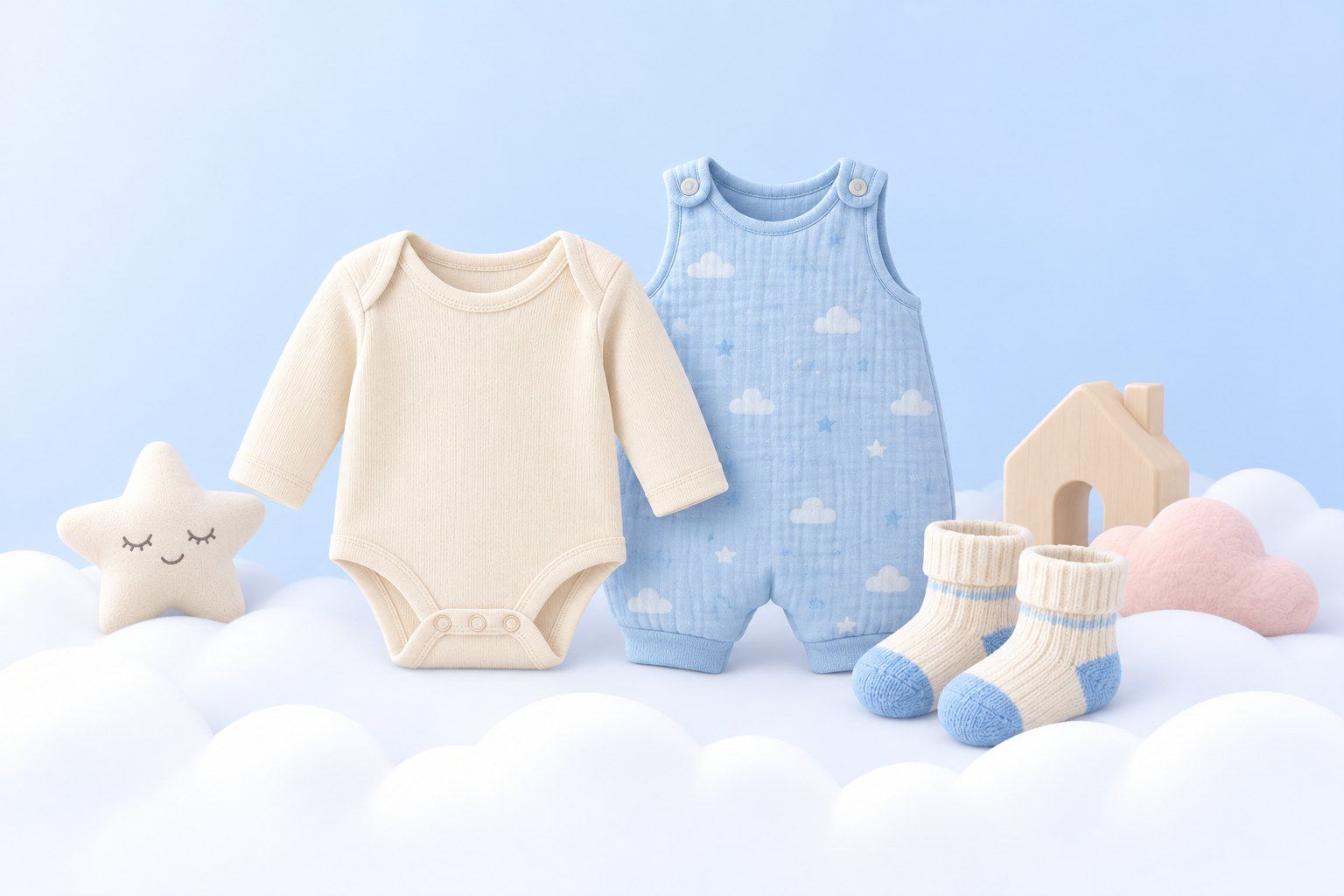
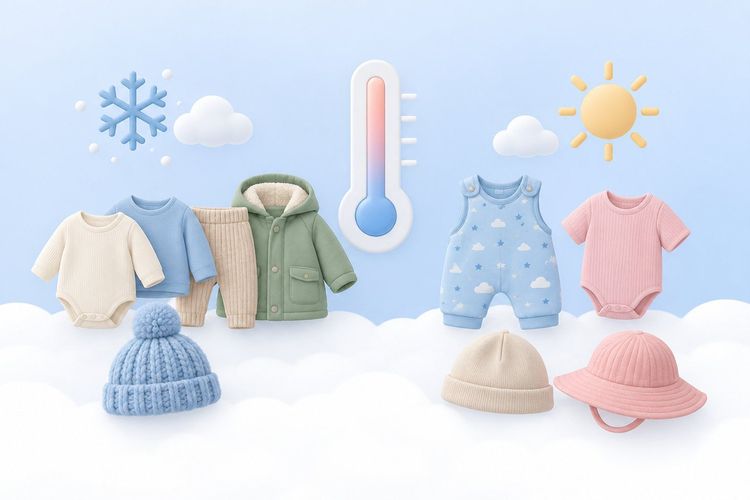
Figuring out the ideal room temperature for baby and what to put on them sounds simple, until you're standing at the dresser in the morning: it's freezing outside, the heat is running inside, and Grandma says “one more layer than you.” The short answer: indoors, the room counts, not the weather. Your baby wears a onesie as the base, one warming layer on top at most, and socks once the room drops below 72 °F (22 °C). Hats, jackets and snowsuits stay by the door.
At a glance
Base
Onesie + 1 layer at most
One more layer
0–2 months, 68–73 °F
Hat indoors
Never, not even in winter
Warm enough?
Neck warm and dry
How to dress baby indoors: a onesie plus one layer at most
At home, the same layering system applies as outside, just without the outer layer. The base is a onesie, or a shirt for toddlers. On top goes one warming layer at most: a cardigan, a sweater or a footie. Pants, tights and socks depend on the room. What gets added outside is in how to dress baby for the weather.
- The footie already counts: So it's a onesie and a footie, or a onesie, pants and a cardigan, not all of it together.
- For newborns: A thin long-sleeve shirt over the onesie is their one warming layer.
- Knits over fleece: Fleece catches fire easily and doesn't belong near a heater.
How to dress baby in the house: chart by room temperature
Whether the heat or the AC is running, find the row that matches your room. In a 72 degree room, for example, a 6-month-old needs just a short-sleeve onesie and light pants. The ranges are guidelines; the neck check tells you whether it really fits.
| Room | 0 to 2 months | 3 to 11 months |
|---|---|---|
| 79 °F and up | Diaper, sleeveless onesie | Diaper, sleeveless onesie |
| 75–78 °F | Diaper, short-sleeve onesie | Diaper, short-sleeve onesie |
| 72–74 °F | Short-sleeve onesie, long-sleeve shirt, light pants | Short-sleeve onesie, light pants |
| 68–71 °F | Long-sleeve onesie, long-sleeve shirt, pants, thin socks | Long-sleeve onesie, pants, thin socks |
| 64–67 °F | Long-sleeve onesie, pants, cardigan, warm socks | Long-sleeve onesie, pants, cardigan, warm socks |
| 61–63 °F | Long-sleeve onesie, tights, pants, cardigan, warm socks | Long-sleeve onesie, tights, pants, sweater, warm socks |
| Below 61 °F | Wool onesie, warm leggings, pants, cardigan, warm socks | Wool onesie, warm leggings, pants, sweater, warm socks |
Daytime clothes around the house; each row applies up to the next one (79 °F = 26 °C, 72 °F = 22 °C, 68 °F = 20 °C, 61 °F = 16 °C). From 9 months, add soft-soled shoes below 68 °F; from 12 months, skip the thin socks at 68–71 °F.
Does my baby need an extra layer indoors, and for how long?
Lots of moms hear the one-more-layer rule. And then you're sitting on the couch in a thin sweater yourself, wondering:
Does my baby really need one more layer than me inside the house?
Indoors, that only applies to the youngest. Up to 2 months, a newborn gets one thin extra layer at around 68–73 °F (20–23 °C), usually a long-sleeve shirt over the onesie. From 3 months, your baby wears no more at home than an adult who feels comfortable in the same room.
At 70 °F (21 °C), that means: at 4 weeks, a long-sleeve onesie, long-sleeve shirt, pants and thin socks; at 3 months, the same without the shirt. If your baby's neck is sweaty even though you're dressing them like in the first weeks, that's often why. Indoors, too warm is the more common mistake.
What's the ideal room temperature for baby during the day?
When parents ask what temperature the house should be for a baby, the daytime answer is mostly a minimum: in the cold months, living spaces should be at least 64 °F (18 °C). A heated home in winter is usually around 68 °F (20 °C) in the living room during the day, and about 70 °F (21 °C) on mild fall days. The 61–68 °F (16–20 °C) you often read about is for the bedroom; more on that in What sleep sack for what temperature?.
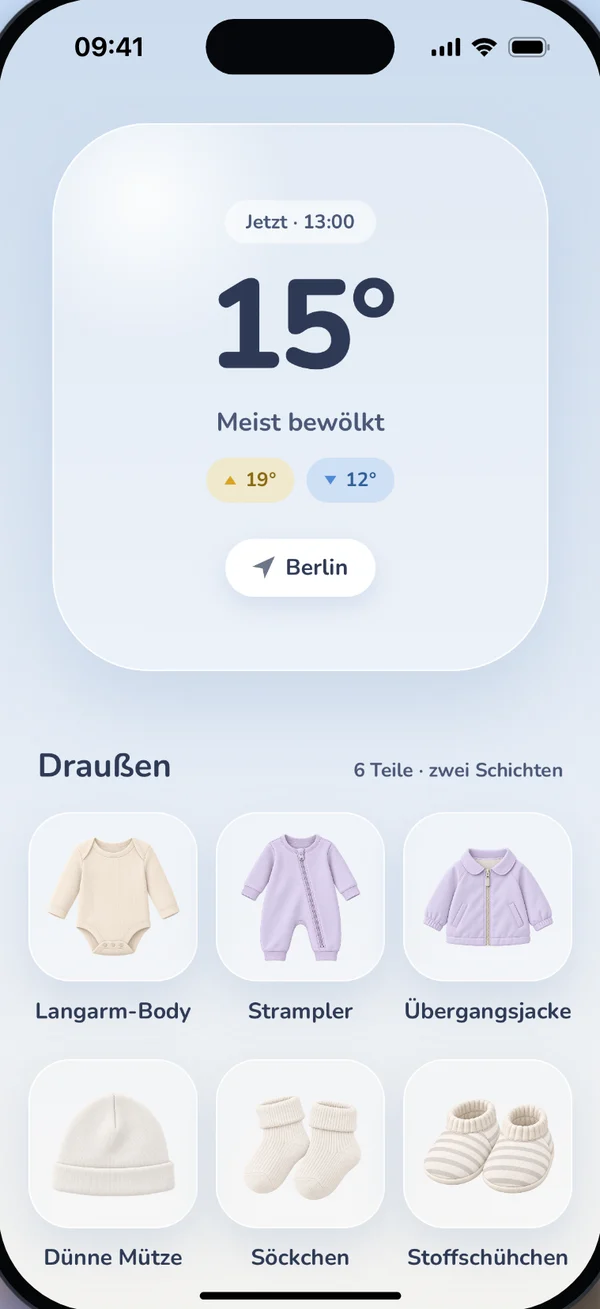
Your own feeling is easily fooled, so a room thermometer helps. The baby weather app BabyWear estimates the room for your country and the season and shows it as “Room ≈ 68°”. For a single home, that can be off by about 5 °F (3 °C), say in an attic room or at Grandma's. If it's warmer at your place, dress lighter and feel the neck.
BabyWear – Weather & Outfits
Dress your baby right: outfits for outdoors, indoors, and sleep, based on the weather.


Try free for 3 days
How to dress baby at home in winter and in summer heat
Below 64 °F (18 °C), a home is a health risk in itself. Warm up the room if you can, and dress your baby in knits or wool instead of a hat or jacket. Below 61 °F (16 °C), get at least the nursery up to 64 °F, and until then check the neck and tummy more often. What applies outside in freezing weather is in how to dress baby in winter.
From 75 °F (24 °C), a diaper and a short-sleeve onesie are enough; from 79 °F (26 °C), a sleeveless onesie. In the heat, your baby can wear just a diaper indoors. Here's how to keep the house cooler:
- During the day: Keep windows closed and blinds down; air the house out at night and early in the morning.
- Coolest room: That's where your baby plays and sleeps. At night, 75 °F and up is too warm, and the bedroom should never go above 79 °F.
- Fan: Never point it straight at your baby, and keep it out of reach. Above 95 °F (35 °C) it no longer protects; then only a cooler room helps.
More on this in how to dress baby in hot weather.
Should baby wear a hat or socks indoors?
No hat indoors, no hood and no mittens, not even for a newborn and not even in a cool room. Your baby releases extra heat through their uncovered head.
Indoors, the hat comes off. The neck tells you whether it's right.
Feel the back of the neck or between the shoulder blades: warm and dry means just right, sweaty means one layer less. If it feels cool, one thin layer more helps; below 64 °F, a warmer room is the better fix. Newborns don't shiver yet when they're cold.
Socks are for comfort, not a sign of warmth. For babies, they're only part of the outfit below 72 °F, and ice-cold feet always get some. When dressing, check that no hair is wrapped around a toe. Soft-soled leather shoes only from 9 months, and only on cool floors.
Coming inside, naps, diaper changes: the moments in between
- Back from a walk: Take off or open the hat, snowsuit and footmuff right away, even if your baby is asleep, and on the bus too.
- Asleep in the car seat or carrier: Move your baby flat into their own crib soon. Outside the car, the car seat is not a place to sleep.
- Naps: Cardigan, sweater, tights and socks come off; only sleepwear goes under the sleep sack. Lay your baby on their back, without a blanket. During the day, the room is often warmer than at night.
- Diaper changes and baths: Warm the room first and cover the upper body with a towel. In the bathroom, about 73–75 °F.
- In a carrier: It warms the upper body too, so use one layer less there. The face stays uncovered, the chin off the chest.
Baby has a cold: dress warmer or lighter at home?
Don't bundle up: dress your baby just as usual for the room, with no extra layer, blanket or hat. Clothes that are too warm can raise their temperature on their own. But don't strip them down to the diaper to bring a fever down, either.
A fever is a reason to call the pediatrician, not to change clothes: under 3 months, get medical advice right away at 100.4 °F (38 °C) or higher; at 3 to 6 months, at 102 °F (39 °C) or higher.
Too warm or too cold?
Red cheeks, sweaty neck, fussiness, floppiness: take off a layer, move somewhere cooler, offer the breast or bottle more often, no water under 6 months. Hot, dry skin, drowsiness: call 911 right away. Cold, floppy, very quiet or not feeding: 911, warm slowly, no hot water bottle.
Toddlers at home: a shirt instead of a onesie, bare feet welcome
From 18 months, your child wears a shirt instead of a onesie, and a wool onesie again only below 61 °F. At 68–71 °F, a long-sleeve shirt and pants are enough; from 72 °F, a T-shirt. A cardigan, warm socks and soft-soled shoes only come in below 68 °F. Bare feet are best indoors; on cool floors, non-slip socks or soft leather slippers help.
BabyWear – Weather & Outfits
Dress your baby right: outfits for outdoors, indoors, and sleep, based on the weather.
Try free for 3 days
Change wet clothes from the playground right at the door. Hoodies only without a drawstring at the neck. If your child gets warm easily, set that in the profile: BabyWear then dresses them a little lighter at home, at 70 °F with a T-shirt instead of a long-sleeve shirt.
Frequently asked questions
Up to 2 months, one thin layer more than you at around 68–73 °F. So at 68–71 °F: a long-sleeve onesie, long-sleeve shirt, pants and thin socks. A newborn never needs a hat indoors.
This article offers guidance, not medical advice. Room temperatures are estimates. If your baby has a fever, seems floppy or you're unsure, ask your pediatrician or midwife. Sources: American Academy of Pediatrics (2022), NHS (2025), The Lullaby Trust (2026), BIOEG (2025), WHO (2018).