 Outdoors0–3 years
How to Dress Baby by Temperature: Chart, Layers and Hats
The chart from 77 °F to freezing: what babies and toddlers wear, which hat when, and how to check they're warm enough.
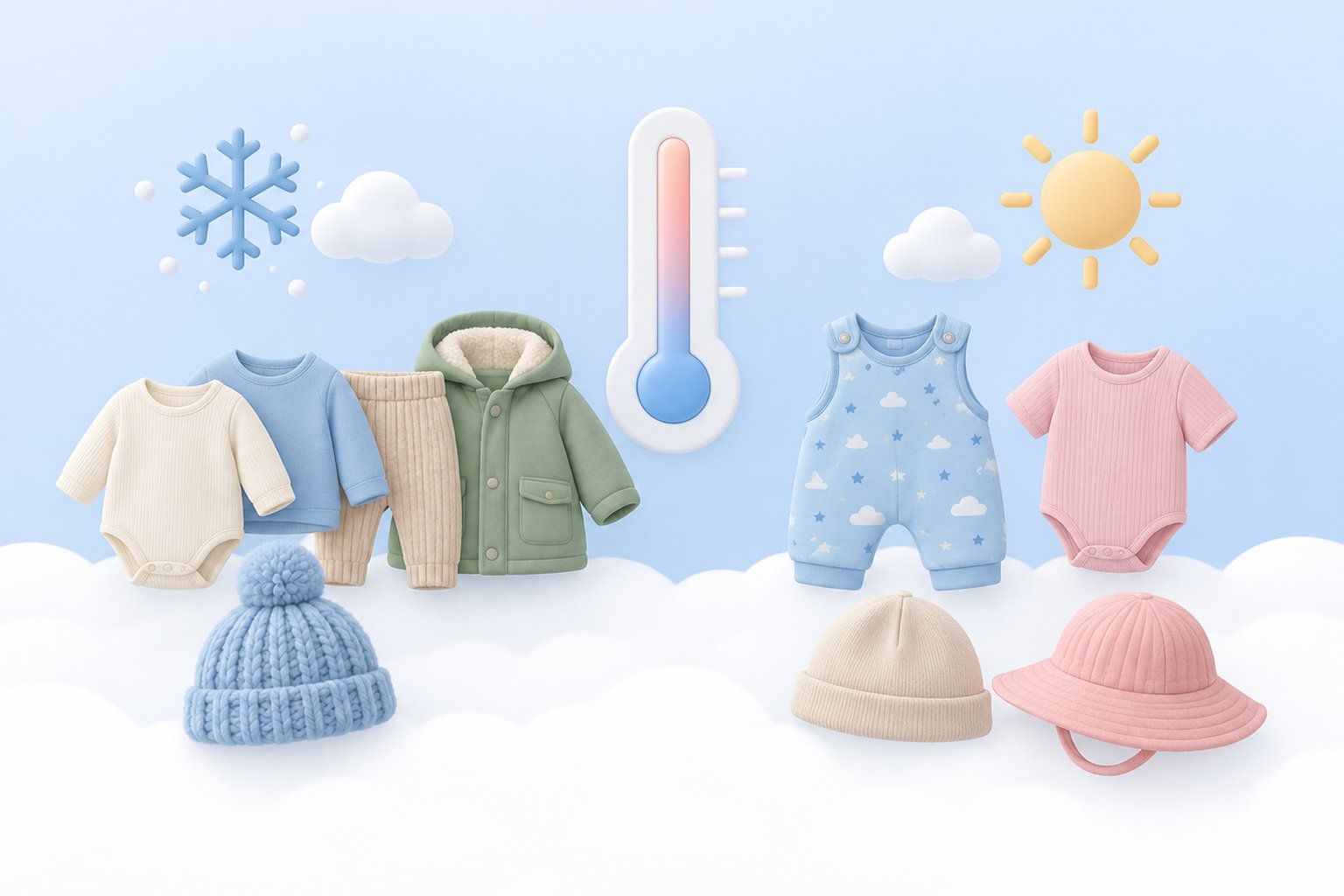
39 °F in the morning, 61 °F by lunch: is your baby too warm or too cold? Babies are more sensitive to cold and heat than adults because their bodies have a lot of surface area for their weight, and young babies don't shiver. How to dress baby by temperature comes down to four steps: check the feels-like temperature, find your row in the chart, pick the hat by the degrees, and feel the back of the neck.
At a glance
Check warmth
at the back of the neck
Warm layer
one at most
Hat
below a feels-like 68 °F
Sun hat, cap
68 °F+ in real sun
Actual or Feels-Like: Which Temperature Counts?
Go by the feels-like temperature: 37 °F (3 °C) with a 12 mph wind feels like about 29 °F (−1.5 °C), so use the colder row.
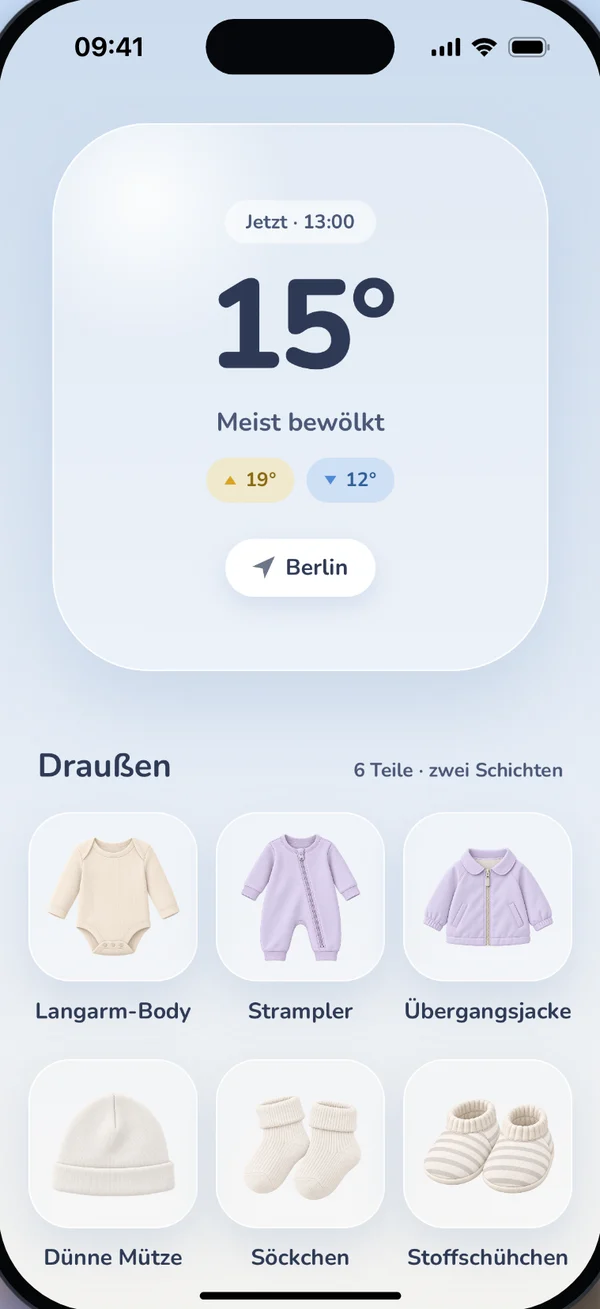
Cold morning, mild afternoon? Below 68 °F (20 °C), dress your child for the coolest part of the outing, with the top layer easy to take off; from 68 °F, the warmest hour counts. To see how to dress your baby for the weather today, the BabyWear baby weather app shows one outfit each for morning, midday, evening and night.
How Many Layers Should a Baby Wear?
At a feels-like 59–67 °F (15–19 °C), two layers; at 41–58 °F (5–14 °C), three: a onesie, at most one warm layer, and a jacket or suit. Colder than that, bundle up warmly. From 68 °F (20 °C), one layer is enough if it isn't raining: a onesie and light pants.
- Base: a onesie or shirt against the skin, wool when it's cold.
- Warm layer: one at most: a footie, cardigan or sweater. The wool fleece suit counts as the outer layer, but under a winter coat it's the warm layer.
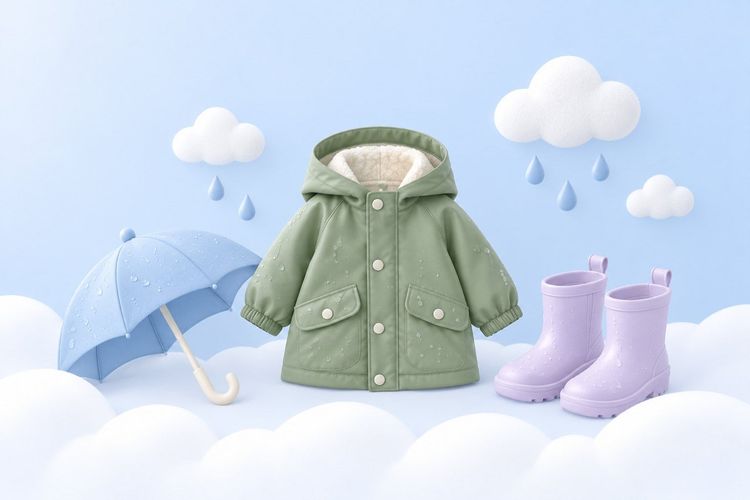
- Outer layer: a jacket or suit as soon as it feels cooler than 68 °F (20 °C) or it's wet. Rain gear replaces the layers it covers instead of going on top.
- Head, hands, feet: hat, mittens and socks to match the temperature.
And the old rule of thumb that babies need more layers than adults? Many parents wonder:
Does my baby really always need one more layer than I do?
No. Outdoors your baby wears at most one more layer on the torso than a comfortably dressed adult, and only when it's below 59 °F (15 °C) and they're lying or sitting still. In warm weather, and at home from 3 months, no more than you. In a carrier, one layer less on the torso, but in the cold keep head, hands, legs and feet covered, the face clear and the chin off the chest.
How to Dress Baby by Temperature: The Chart From 77 °F to Freezing
This baby clothing temperature chart shows the youngest babies and toddlers. In between: from 3 months, a sweater instead of the cardigan. From 6 to 17 months, pants instead of the footie at 50 °F and up, a sweater and light jacket instead of the suit at 50–58 °F, and the snowsuit already below 32 °F.
| Feels like | Baby 0 to 5 months | Toddler from 18 months |
|---|---|---|
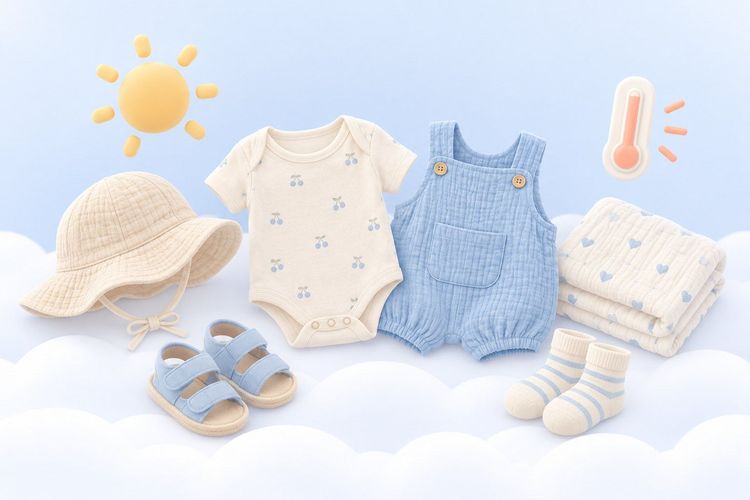
| 77 °F and up | Long-sleeve onesie, light pants, socks, sun hat in real sun | UV shirt, light pants, shoes, cap with a neck flap in real sun |
| 68–76 °F | Long-sleeve onesie, light pants, socks, sun hat in real sun | Long-sleeve shirt, light pants, socks, shoes, cap with a neck flap in real sun |
| 59–67 °F | Long-sleeve onesie, footie, light jacket, thin beanie, socks, cloth shoes | Long-sleeve shirt, pants, light jacket, thin beanie, socks, shoes |
| 50–58 °F | Long-sleeve onesie, footie, wool fleece suit, thin beanie, warm socks, light blanket | Long-sleeve shirt, pants, sweater, light jacket, thin beanie, socks, shoes |
| 41–49 °F | Long-sleeve onesie, tights, pants, cardigan, wool fleece suit, warm hat, warm socks, warm blanket | Long-sleeve onesie, tights, pants, sweater, light jacket, warm hat, warm socks, shoes |
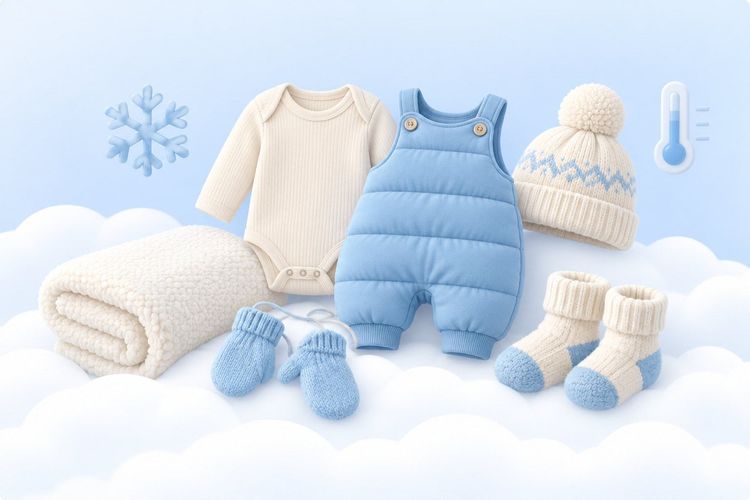
| 32–40 °F | Wool onesie, tights, cardigan, wool fleece suit, warm hat, mittens, warm socks, footmuff | Wool onesie, tights, sweater, winter coat, snow pants, warm hat, mittens, warm socks, winter boots |
| 23–31 °F | Wool onesie, warm leggings, cardigan, wool fleece suit, balaclava, warm hat, mittens, warm socks, footmuff | Wool onesie, wool fleece suit, winter coat, snow pants, balaclava, warm hat, mittens, warm socks, winter boots |
| below 23 °F | Wool onesie, warm leggings, cardigan, snowsuit, balaclava, warm hat, warm socks, footmuff | Same as 23–31 °F |
Sun hat or cap in real sun, even when it's cloudy. Never put a blanket or footmuff over your baby's face or the stroller opening.
Why long sleeves at 77 °F and up? In the first year, keep your baby out of direct sun; thin, long clothing protects, even under clouds. Only when the UV index is below 1, early or late in the day, is a short-sleeve onesie enough. More in how to dress baby in summer.
When Should Baby Wear a Hat, and Which One?
Below a feels-like 68 °F (20 °C), your baby needs a warm hat outdoors, in the stroller and in sunshine too. From 68 °F in real sun, a sun hat; otherwise nothing. Real sun means a UV index of 1 or higher in the first year, 3 or higher after that, even when it's cloudy. Never two pieces of headwear, except in freezing cold:
- Below 32 °F (0 °C): a balaclava under the warm hat, mouth and nose clear, no scarf, no cords. White patches on cheeks, nose, ears or fingers: get somewhere warm right away; cream doesn't protect against frostbite.
- 32–49 °F (0–9 °C): the warm hat, pulled down over the ears.
- 50–67 °F (10–19 °C): the thin beanie, even in sunshine: the canopy, shade and clothing provide the protection.
- 68 °F (20 °C) and up: no knit hat; in real sun the sun hat, from 18 months the cap with a neck flap.
- Indoors, in the car, in bed: no hat, not even for newborns.
Your baby loses heat through their head. If your toddler pulls the hat off, put it back on.
BabyWear – Weather & Outfits
Dress your baby right: outfits for outdoors, indoors, and sleep, based on the weather.


Try free for 3 days
Is Your Baby Too Hot or Too Cold? Feel the Back of the Neck
Here's how to tell if your baby is too cold or too warm: feel the back of the neck or between the shoulder blades. Warm and dry is just right, sweaty means one layer less, cool means one more. Cool hands and feet are normal. From around two to three years, your child will usually tell you when they're cold.
Cool hands are normal. The back of the neck tells you if it's right.
- Dressed too warmly: red cheeks, a sweaty neck, fussiness or floppiness: take off a layer, move somewhere cooler, offer plenty to drink; under 6 months, breast milk or formula instead of water.
- Too cold: a cool neck. Add a layer or go somewhere warm. Young babies can't shiver yet.
- Call 911 right away: if your baby has hot, dry skin or seems dazed, or feels cold, is floppy, unusually quiet or won't feed. Warm them up slowly: no hot bath, no hot-water bottle.
Freezing Cold, Heat Waves, Colds, Active Play: What Changes?
- Freezing cold: Under 3 months, at a feels-like 23 °F (−5 °C) or colder, or at 32 °F (0 °C) or colder with wind of 9 mph or more, better stay inside or keep it short; at 3 to 5 months, short trips only. At a feels-like 14 °F (−10 °C) or colder, everyone is better off inside, otherwise only briefly, with no carrier and no stroller naps outdoors. More in how to dress baby in winter.
- Heat wave: From 86 °F (30 °C), stay indoors or in deep shade from 10 a.m. to 5 p.m.; from a feels-like 90 °F (32 °C), only very short trips early or late; from a feels-like 100 °F (38 °C), stay in the coolest room.
- Cold or fever: don't dress your child more warmly. With a fever, get medical advice right away: under 3 months from a body temperature of 100.4 °F (38 °C), at 3 to 6 months from 102 °F (39 °C).
- Heading inside: On the bus, in a store, at Grandma's: hat off, suit and footmuff open, even if your baby is asleep. In the car seat, every suit comes off, wool fleece too, along with footmuff, hat and mittens; a blanket goes over the snug harness.
- Active play: When they're running around, the sweater can come off for a while; change wet clothes right away.
At Home and at Night: The Short Version
Indoors: no outer layer, hat or mittens. At 68–70 °F (20–21 °C): from 3 to 11 months a long-sleeve onesie, pants and socks; from one year a onesie or shirt and pants; under 3 months, add a thin long-sleeve shirt. More in how to dress baby at home.
BabyWear – Weather & Outfits
Dress your baby right: outfits for outdoors, indoors, and sleep, based on the weather.
Try free for 3 days
At night, the bedroom counts, not the season: ideally 61–68 °F (16–20 °C), in Germany 61–64 °F (16–18 °C), best around 64 °F (18 °C). Measure by the crib: BabyWear estimates the room for your country and season, you enter your reading and see the TOG rating, the warmth rating of a sleep sack. All levels: Which sleep sack for which temperature?
Safe sleep
No hat in bed, not even with a cold. No blanket, pillow, stuffed animals, socks or hot-water bottle: warmth comes from the room or the sleep sack. Sleep only on the back, in a sleep sack.
Frequently asked questions
At a feels-like 68–76 °F (20–24 °C), so on a 70- or 75-degree day, one layer: a long-sleeve onesie, light pants and socks. In real sun, which in the first year means a UV index of 1 or higher, even when cloudy, add a sun hat. Don't drape a cloth over the stroller.
This article offers guidance, not medical advice. If your child seems floppy or has a fever, talk to your pediatrician or midwife. Sources: BIOEG (2025), BfS (2026), 1177 Vårdguiden (2022), AAP (2022), NHS (2025), The Lullaby Trust (2026), Helsenorge (2023), DWD (2026), ECCC (2025).